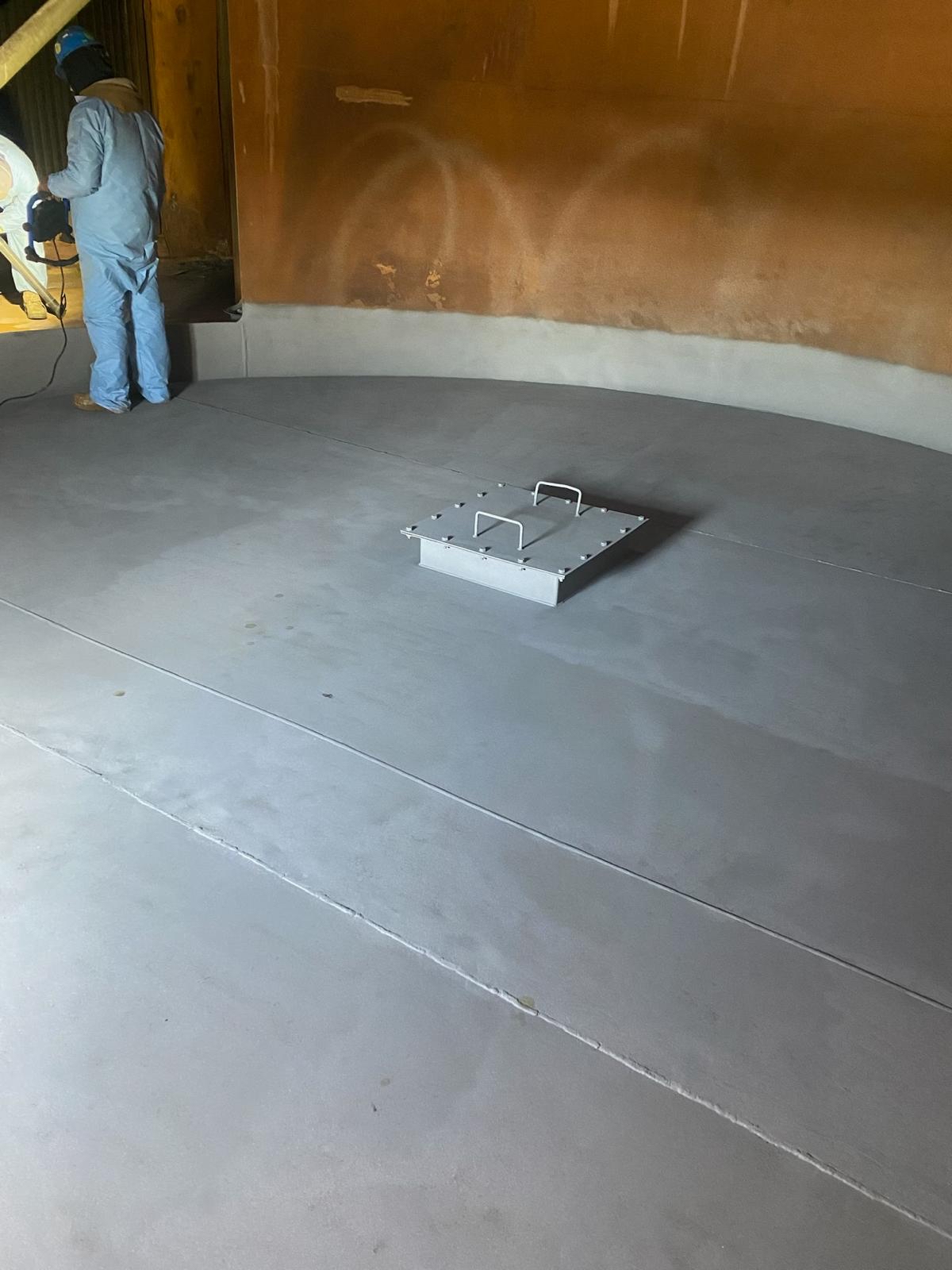
If you are planning a petroleum storagetank lining projectand a contractor has proposed water blasting as the surface preparation method - either as a cost-saving measure or as a marketed advantage - this post is for you. Water blasting is a legitimatesurface preparation techniquewith real applications in the coatings industry. Tank lining for petroleum immersion service under API Standard 652 is not one of them.
This distinction matters because it affects whether your tank lining will perform for its intended service life - or fail years early, potentially requiring a full re-entry, complete lining removal, and costly emergency downtime that the original 'savings' will not come close to covering.
What Is API 652 and Who Does It Apply To?
API Recommended Practice 652 - Linings of Aboveground Petroleum Storage Tank Bottoms - is the governing industry standard for interior lining of above-ground storage tanks (ASTs) that store petroleum products, including gasoline, diesel, jet fuel, heating oil, and refined fuel blends. Published by the American Petroleum Institute, it provides guidance on when lining is appropriate, how to select a lining system, how to prepare the surface, how to apply and inspect the lining, and how to evaluate and repair existing linings.
API 652 applies to any operator, engineer, or contractor working on petroleum AST lining - whether at a petroleum terminal, a refinery, a fuel distribution facility, or a manufacturing plant with petroleum product storage. If a specification references API 652, that reference carries specific requirements for surface preparation that are not optional and not subject to substitution without documented engineering justification.
What API 652 Section 7 Actually Says About Surface Preparation
API 652 Section 7 addresses surface preparation directly and without ambiguity. The standard describes surface preparation as a critical part of the lining application process, notes that continuous immersion service is a severe exposure condition, and states that inadequate surface preparation is a major cause of lining failure.
On the method of surface preparation, the standard is clear: abrasive blast cleaning to a near-white or white metal finish is the required standard for petroleum storage tank interior lining. The standard references NACE No. 2 / SSPC-SP10 Near-White Metal Blast Cleaning as the basis for achieving the cleanliness and surface profile required for proper lining adhesion in immersion service.
Equally important, API 652 specifies the surface profile - the anchor pattern - required for lining systems. The profile depth for tank linings is typically 1.5 to 4.0 mils (38 to 102 microns), depending on the lining system. This profile must be sharp and angular to provide the mechanical adhesion that a lining under continuous petroleum immersion service requires. The standard notes that recycled abrasive media may not reliably produce the required profile sharpness and angularity, and recommends that operators weigh this risk when specifying blasting media.
The Role of Surface Profile in Tank Lining Performance
Surface profile - the microscopic peaks and valleys created by abrasive blasting on the steel surface - is not simply a cosmetic measure of how thoroughly the steel has been cleaned. It is the physical mechanism by which a tank lining achieves mechanical adhesion to the steel substrate.
A tank lining epoxy does not bond to flat steel the way paint bonds to a wall. In petroleum immersion service, the lining is under constant hydrostatic pressure from the stored product, continuous chemical exposure, and thermal cycling. Without the mechanical interlocking between the cured epoxy and the peaks and valleys of the blasted steel surface, the lining relies almost entirely on chemical adhesion - which is insufficient for long-term immersion service performance. This is why the profile depth and sharpness are specified values, not approximate targets.
Abrasive blasting creates this profile by propelling sharp, hard abrasive particles at high velocity against the steel surface, physically cutting into the metal to produce the required texture. The profile depth and sharpness depend on the abrasive type, particle size, blast pressure, and nozzle distance - all of which a trained blasting crew adjusts to meet the specified anchor pattern.
What Water Blasting Can and Cannot Do
Water blasting - also called waterjetting or hydrojetting - uses high-pressure water, rather than abrasive media, to clean a steel surface. It is highly effective at removing water-soluble surface contaminants, including soluble salts and chlorides, which are contaminants that abrasive blasting alone does not reliably remove. For this reason, waterjetting is a legitimate and sometimes preferred method for specific applications: removing lead paint with minimal airborne dust, decontaminating heavily salt-laden marine structures before recoating, and cleaning surfaces that already have an adequate pre-existing anchor profile from prior abrasive blasting.
What waterjetting cannot do - and what SSPC's own waterjet cleaning standards explicitly state - is create a surface profile on steel. SSPC-SP WJ-1 through WJ-4, the published waterjet cleaning standards, do not include surface profile as part of their cleanliness requirements because waterjetting does not produce a profile. The water jet removes coatings and contaminants from the surface, but the kinetic energy of water molecules does not cut into the steel substrate the way abrasive particles do.
This is the fundamental technical reason why water blasting cannot substitute for abrasive blasting as the surface preparation method for API 652 petroleum storage tank interior lining. A water-blasted steel surface - even one that is visually clean and free of rust - lacks the anchor profile required for the mechanical adhesion of an immersion-service tank lining. Applying a tank lining over an inadequate profile is not a reduced-cost alternative; it is a deferred failure.
| Factor | Abrasive Blasting | Water Blasting / Waterjetting |
|---|---|---|
| Surface profile (anchor pattern) | Creates a new profile to specification (1.5 - 4.0 mils for tank lining) | Does not create a surface profile - can only reveal an existing one |
| API 652 compliance | Required by API 652 Section 7 for petroleum storage tank lining | Not a recognized substitute for API 652 immersion service lining |
| Mill scale removal | Removes mill scale completely when blasted to SP-10 or SP-5 | Does not reliably remove tightly adhered mill scale |
| Soluble salt removal | Does not remove soluble salts - requires pre-treatment | Effective at removing soluble salts and chlorides from surface |
| Coating adhesion | Produces sharp, angular profile that maximizes mechanical adhesion | Relies on pre-existing profile - adhesion depends on original prep quality |
| Flash rust risk | No flash rust on dry steel | Steel flash rusts after waterjetting - requires rapid coating or inhibitor |
| Applicable SSPC standard | SP-5, SP-10, SP-6 (dry abrasive blast) | WJ-1 through WJ-4 (waterjet) - separate standard set, not equivalent to SP-10 |
| Appropriate use case | New tank lining, full lining replacement, immersion service | Maintenance overcoating where adequate profile already exists; salt decontamination |
When Is Water Blasting Appropriate?
Water blasting is not a universally inferior method - it is a method with appropriate and inappropriate applications. The coatings industry uses it successfully in several contexts:
- Maintenance overcoating on existing coated structures where an adequate surface profile already exists from prior abrasive blasting and the objective is to remove loose material and contamination before applying a maintenance coat
- Decontaminating heavily salt-laden or chloride-contaminated steel surfaces before abrasive blasting - in this sequence, waterjet decontamination followed by abrasive blasting can produce better overall results than abrasive blasting alone
- Removing hazardous materials including lead paint in environments where airborne dust from dry abrasive blasting creates respiratory hazards or environmental compliance issues
- Marine maintenance applications where existing profile is confirmed adequate and salt removal is the primary objective
In none of these applications is waterjetting used as the sole surface preparation method immediately before applying a new immersion-service lining on a petroleum storage tank. That is the specific combination that API 652 does not permit.
The Cost of Getting This Wrong
Petroleum storage tank lining failures are not minor maintenance events. A lining failure in an active petroleum terminal means tank entry, full lining removal by mechanical or chemical means, repeat abrasive blasting to the correct standard, a new lining application, and cure time before the tank can return to service. At major terminals, a single tank out of service for an unplanned lining failure can mean tens of thousands of dollars in lost throughput per day, in addition to the direct cost of the repeat work.
A contractor who proposes water blasting as a cost-saving alternative to abrasive blasting for API 652 tank lining work is not offering a lower-cost path to the same outcome. They are proposing a surface preparation method that is inconsistent with the governing standard for this work - one that will likely result in lining failure before the end of its designed service life, with the full cost of failure falling on the tank operator.
Key question to ask: Any contractor proposing water blasting for petroleum storage tank interior lining should be asked directly: how do you achieve the required surface profile without abrasive blasting, and how does your proposal comply with API 652 Section 7? A technically sound answer to that question does not exist.
What to Ask Your Tank Lining Contractor
Before committing to any petroleum storage tank lining project, these are the questions that separate technically qualified contractors from those who are not:
- What SSPC surface preparation standard will you achieve? The answer for API 652 immersion service should be SP-10 at minimum, and SP-5 is specified for some lining systems.
- What abrasive media will you use, and how will you verify the surface profile? The contractor should specify the abrasive type (steel grit, garnet, or other angular media), the target profile depth in mils, and the measurement method (Testex tape or digital profilometer).
- How will you verify that soluble salt contamination is controlled? Soluble salts on the steel surface cause osmotic blistering under the lining. The contractor should describe their pre-blast cleaning procedure and whether they test for chloride contamination before lining application.
- Who will perform QA/QC inspection, and what are their credentials? For API 652 work, the inspector should be NACE CIP Level 2 or Level 3 certified. Inspection should include surface preparation verification, ambient condition monitoring, wet and dry film thickness readings, and holiday testing of the completed lining.
- What documentation will you provide? The deliverable should include surface preparation records, ambient condition logs, lining material batch records, DFT readings, holiday test results, and a final inspection report.
Working with NJ Reliable Coatings on API 652 Tank Lining Projects
NJ Reliable Coatingsperforms API 652-compliant petroleum storage tank interior lining at terminals, refineries, and industrial facilities throughout New Jersey and the surrounding region. All tank lining projects are prepared with SSPC SP-10 Near-White Metal abrasive blasting as standard - not waterjet cleaning, not power tool cleaning, not commercial blast. Our in-house NACE CIP Level 3 inspector verifies surface preparation before lining application and provides complete project documentation packages for terminal operator and NJDEP compliance submissions.
We are approved applicators for Carboline, PPG, Sherwin-Williams, Tnemec, International, and Belzona - covering the full range of epoxy, novolac epoxy, and glass flake lining systems specified for gasoline, diesel, jet fuel, ethanol, and chemical storage in petroleum immersion service.
Contact us: 908-315-4723- or visitnjreliablecoatings.comto discuss your tank lining project and surface preparation requirements.